

Interpolation
Overview
Everything is related to everything else, but near things are more related than distant things.Waldo Tobler, The First Law of Geography
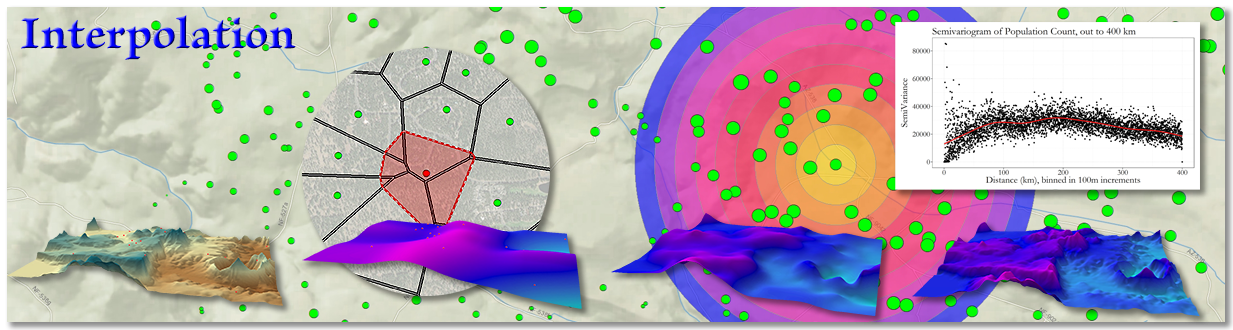
Interpolation is essentially the act of estimating the value at one location based on known values at nearby locations. We use it when we want to estimate the values of some variable (like elevation, soil chemistry or pollution levels) across the entire landscape, based on values we measure at a few sample locations. If we measure the pH level at one location, for example, then there's a good chance that the region right next to that location has a very similar pH level.
What is not interpolation? Interpolation is not like most predictive statistical models, where you predict a response variable (habitat suitability, for example) based on a statistical model of one or more predictor variables. Interpolation is based entirely on observed values of that variable at other locations, not from combinations of predictive variables producing some response. Interpolation is also not a method of predicting rates of occurrence based on counts of observation, like the density tools.
There are lots of ways to do interpolation, each of which are appropriate in different circumstances. In this module we will discuss the basic techniques available in Spatial Analyst. There are a number of more advanced variations on these techniques available in the Geostatistical Analyst extension.
Please step through the PowerPoint lecture Interpolation while reviewing the slide notes in the document Interpolation: Lecture Notes and Lab Exercises, and then work through the lab exercises.
All the lab exercises are presented in the document Interpolation: Lecture Notes and Lab Exercises. Remember, the lab exercises are where you really learn the material, so take advantage of them! I'm here and excited to answer any questions you have, or help out if you get stuck on anything.
Lectures and lab videos
The lecture videos for this module are not online yet; the slides and the written lecture notes and lab exercises below cover the material.
The lab exercise videos for this module are not online yet; the slides and the written lecture notes and lab exercises below cover the material.
Slides, notes and downloads
Here is a written discussion that goes with the lecture videos, and step-by-step instructions on how to do the lab exercises. You need to download this one to do the lab exercises!