

The Recreation Opportunity Spectrum (ROS)
Overview
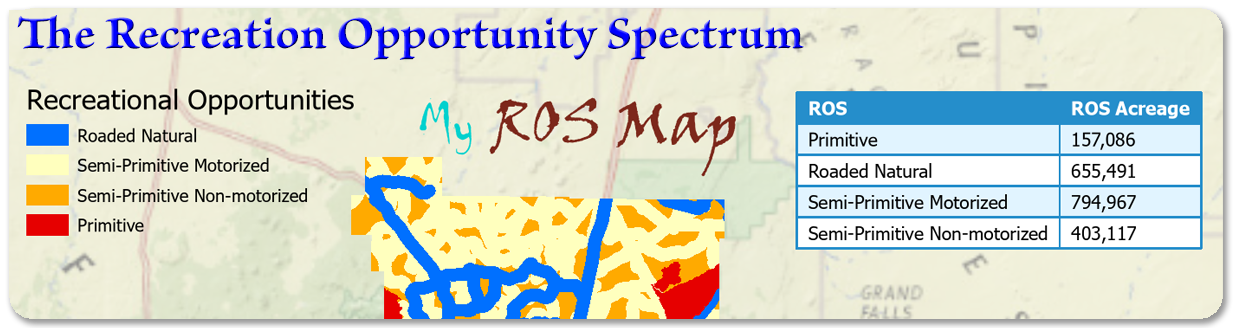
Here we learn how to use the basic ArcGIS Pro vector analysis tools to partition the Coconino National Forest into regions appropriate for different recreational opportunities, using a system called the Recreation Opportunity Spectrum (ROS). In this system, recreational experiences are classified according to accessibility, under the assumption that some people prefer easy-to-get-to sites while others prefer remote and isolated locations.
All the lab exercises will contribute to a final ROS map and analysis of how much of the Coconino National Forest can be classified into each ROS category, and are presented in the document Recreation Opportunity Spectrum: Lab Exercises. Remember, the lab exercises are where you really learn the material, so take advantage of them! I'm here and excited to answer any questions you have, or help out if you get stuck on anything.
Lectures and lab videos
The lecture videos for this module are not online yet; the slides and the written lecture notes and lab exercises below cover the material.
The lab exercise videos for this module are not online yet; the slides and the written lecture notes and lab exercises below cover the material.
Slides, notes and downloads
Here is a written discussion that goes with the lecture videos, and step-by-step instructions on how to do the lab exercises. You need to download this one to do the lab exercises!
This geodatabase contains the intermediate data you will calculate during your ROS lab. If ArcGIS chokes on you for any reason, or if you are just unable to get a tool to work correctly, you can just grab that intermediate dataset out of this geodatabase. Don't use this unless you have to, though!
An interesting article discussing how ROS can be used predictively, to help guide land management planning.
Harshaw, H.W. and S.R.J. Sheppard. 2013. Using the recreation opportunity spectrum to evaluate the temporal impacts of timber harvesting on outdoor recreation settings. Journal of Outdoor Recreation and Tourism 1–2, p. 40–50